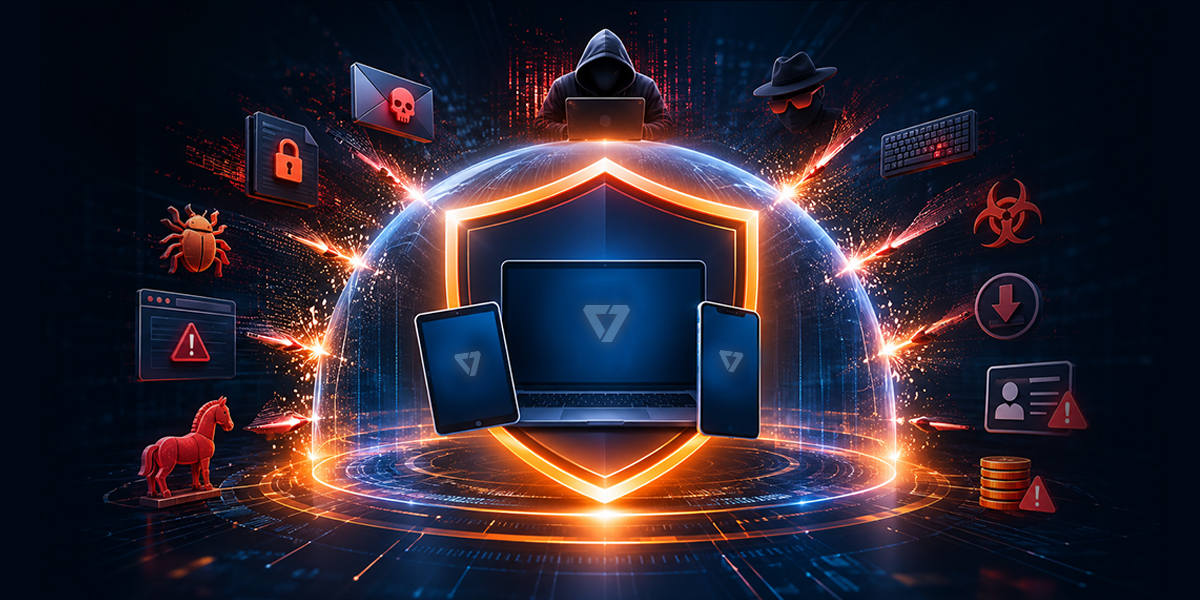
Every time you use any digital device, you immediately and continuously face a multitude of threats. Over 70 million new threats have been identified just this year. Some of these threats target you indirectly through your device, and some target you directly through social engineering. These threats may steal your money or identity, spy on you, or impact you in other ways.
Irrespective of how they work or the motivation of the attackers, these threats make life significantly worse. Digital technology touches every facet of our lives and, therefore, protecting our digital life is now a priority for all of us. K7 is dedicated to improving the quality of life for all netizens and we will explore how our technology protects digital users against the barrage of threats that are encountered on every device and platform.
The Challenge – The Wide Variety of Digital Threats
‘Antivirus’ is the widely-used term for digital protection but the digital threats we encounter are not limited to viruses. These are just some of the cyberattacks we may face:
- An email we receive may have an infected attachment
- Ransomware will demand payment to allow us to use our device
- A link in a text message may lead to a malicious website
- A website may download malware to our device
- A keylogger may record our passwords as we type them
- Our webcam may be hacked to spy on us
Some of these threats strike immediately. Some lie dormant and will launch when a specific date or event occurs. Some threats exploit flaws in software that even the developers are unaware of. The wide variety of threats, and how they may enter a user’s device, necessitate creating superior technology to defend against them.
The Solution – K7’s Advanced Protection
K7 is a global pioneer in cybersecurity, with over 30 years’ expertise in protecting the world against cyberattacks. We create digital defences based on our experience and technical prowess, delivering superior protection for individuals and entrepreneurs. We will examine some of the methods we use to protect against threats.
Types of Scans
We previously mentioned that threats may strike immediately or lie dormant before launching. K7 guards against both types with different types of scans.
Real-time Scan
Every file or link is scanned before it is opened or accessed. For example, an email attachment will be scanned when the user tries to open the file; any threat in the file will be identified before the file opens and the threat will be unable to launch.
Scheduled Scan
These scans run at scheduled intervals and scan all files on the user’s device irrespective of whether they are used or not. Any threat that lies dormant, or entered the device before K7’s protection was installed, will be identified and blocked before it can launch.
Types of Detection
A user may encounter threats that are known to exist, or completely unknown (zero-day) attacks. K7 identifies both types through signature- and behaviour-based detection.
Signature-based Detection
K7 Labs gathers samples of malware from around the world through industry collaborations and alliances, honeypots, darknet forums, and our own telemetry data. Hundreds of thousands of threat samples are analysed every day and signatures are developed that detect malware by matching patterns found in the malware sample. These signatures are distributed multiple times a day to K7 users to ensure they are always protected against the latest threats.
Behaviour-based/Heuristic Detection
Cyberattackers try to evade detection through obfuscation i.e., disguising their malware to prevent signature matching. New attacks may also be launched for which a signature is not yet available. Behaviour-based/heuristic detection is used by K7 to protect against such threats, where abnormal or suspicious characteristics/behaviour is identified and the threat is blocked. K7 registered a perfect score in a test conducted by Neil J. Rubenking, the Lead Analyst for Security at PCMag, which simulated zero-day attacks, indicating that K7’s users need not worry about attacks even if they are the first to encounter that threat.
Multi-layered Artificial intelligence Technology (MAT)
Attacks can occur in multiple stages, targeting different areas of a user’s device. To ensure comprehensive protection, K7 combines defences deployed across multiple layers spanning Pre-Download, Pre-Execution, and Post-execution protection, with Artificial Intelligence models that self-learn, classify, and act autonomously to block malicious/inappropriate websites, malicious activities, and ransomware.
Bringing It All Together to Block Threats
Now that we have understood some of the technologies K7 uses to defend netizens, we will discuss common attacks and how K7 defends against them.
Malware – A general term for malicious software that is designed to damage or take control of your device, or steal your data. K7’s real-time scanning identifies malicious files or applications when they are accessed or activated, and scheduled scans spot malware even if its dormant.
Intrusions – These are attempts by hackers to compromise your device by checking for gaps through which they can enter. K7 includes a Smart Firewall with Host-based Intrusion Prevention System/Host-based Intrusion Detection System (HIPS/HIDS) to prevent entry (and exit) of network data traffic that could form part of an attack.
Ransomware – The attacker encrypts the files on your device and demands a payment to provide the decryption keys. K7 uses both signature- and behaviour-based detection to spot and stop ransomware, while allowing genuine encryption. Ransomware may also attack your device when present on another machine that connects to your device (remote ransomware), which cannot be detected by conventional antivirus. K7’s proprietary Deception Technology ensures protection against all ransomware including remote ransomware.
Phishing – A form of social engineering where the user is persuaded by the attacker to perform an action that is against their best interests e.g., the attacker sends an email with a link to a malicious website designed to mimic the user’s bank’s website, to steal the user’s banking credentials when they attempt to login to their bank account. K7 includes phishing protection that blocks phishing websites and links.
Spyware – Threats that are designed to track how the device is used and send reports to an attacker, such as keyloggers that record keyboard input to steal passwords, or use the webcam to spy on the user. K7’s protection against spyware includes scans that identify malicious software designed to steal user data; a virtual keyboard for extra protection against keyloggers; and webcam protection that restricts or blocks access to the webcam.
Trojans – Malware that is designed to appear benign/beneficial, to trick users into downloading and launching the file. K7 identifies Trojans by generating signatures for known Trojans and identifying suspicious behaviour for unknown Trojans.
Malicious Websites – These may be websites that are created by attackers and designed to infect visitors who visit them, or genuine websites that have been compromised by hackers. K7 protects users by blocking malicious websites when the user attempts to visit them; highlighting unsafe websites when they are listed in search results; and blocking drive-by downloads (a malicious file that downloads automatically without any user action when a webpage loads).
Online Scams – A different form of social engineering where a user is tricked into making a payment. K7 automatically blocks spam websites and links.
Identity Threats – Theft of user’s personal data can lead to the user’s identity being stolen. K7 warns if designated personal data is being transmitted from the user’s device, and includes a data locker for additional security for sensitive documents, photos, and videos.
Unsafe Downloads – Any file downloaded from the internet could be laced with malware. K7 checks all files as they are downloaded, in real time, to maintain user safety.
Emerging Threats – Many new threats emerge every day, and some of these threats may reach the user before K7 Labs receives them for analysis. As discussed above in the section on Behaviour-based/Heuristic Detection, K7 protects users against such threats by examining their behavior for malicious activity.
Fileless Malware – Some malware run as scripts inside other programs and, therefore, there is no file to be scanned. K7 leverages the Windows Antimalware Scan Interface (AMSI) to identify and stop such fileless malware.
K7 Computing protects against these, and many other, cyberattacks by using our advanced proprietary technology backed by research from the state-of-the-art K7 Labs. We are one of a few global cybersecurity providers to have developed a proprietary scan engine that has been the recipient of numerous international awards, and our products are world-renowned for protecting without slowing down your device or network.
K7 protects Windows, Mac, Android, and iOS, and we offer products with varying security features to suit your needs. Please check our Products page to identify a K7 product that is the right fit for your digital lifestyle and habits.